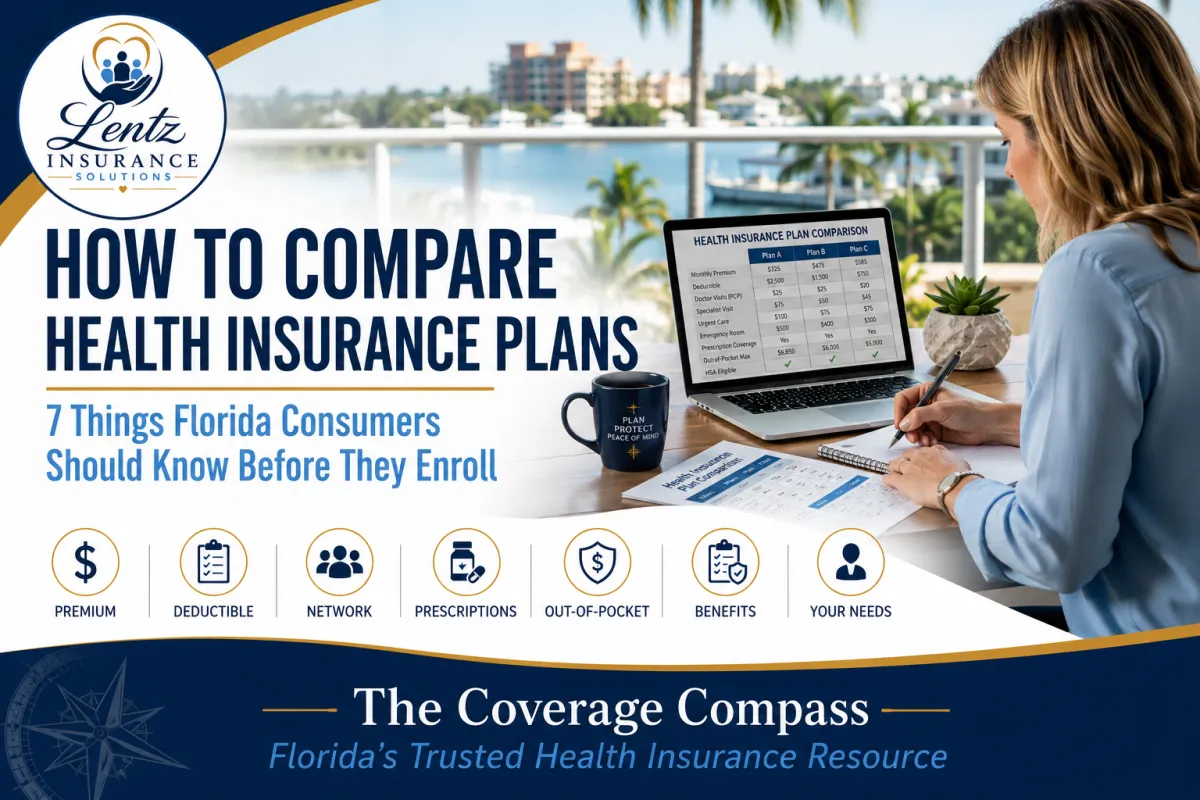
How to Compare Health Insurance Plans in Florida | 7 Things to Know Blog Post
How to Compare Health Insurance Plans in Florida: 7 Things to Look At Before You Enroll
Choosing health insurance can feel overwhelming.
You may open a plan comparison page and immediately see dozens of numbers:
Premium. Deductible. Copay. Coinsurance. Out-of-pocket maximum. Network. Prescription coverage.
And then there's the question that often gets the most attention:
"How much does it cost per month?"
The monthly premium is important—but it is only one piece of the puzzle.
A health insurance plan with a lower monthly premium isn't necessarily the least expensive option overall. Likewise, paying a little more each month may make sense if the plan offers the provider network, benefits, and cost-sharing structure you actually need.
Whether you're shopping for Marketplace coverage, exploring private health insurance, or reviewing your existing plan, here are seven things to compare before you enroll.
1. Start With the Type of Health Insurance Plan
Before comparing premiums, understand what type of coverage you're actually considering.
For example, Marketplace plans are sold through the Health Insurance Marketplace and follow Affordable Care Act requirements. Depending on eligibility, consumers may also qualify for financial assistance through the Marketplace.
Private health insurance options outside the Marketplace can have different eligibility requirements, benefits, networks, and enrollment rules.
If you're still trying to understand the difference, our guide to Private Health Insurance vs. ACA Marketplace Plans provides a closer look at the two approaches.
The first step isn't choosing the cheapest plan.
It's understanding what you're comparing.
2. Compare the Monthly Premium
The premium is the amount you pay for health insurance each month, whether or not you use medical services.
It's an important number—but it shouldn't be the only number you look at.
A plan with a $300 monthly premium may look better than a plan costing $450 per month.
But what happens when you need medical care?
That's where the rest of the plan's cost structure becomes important.
Before choosing based on premium alone, ask:
What will I pay when I actually use this insurance?
3. Look Beyond the Premium
Three numbers deserve particular attention:
Deductible
The deductible is what you generally pay for covered services before your plan begins paying its share, subject to the plan's rules.
Copayments and Coinsurance
A copayment is generally a fixed amount you pay for a covered service.
Coinsurance is generally a percentage of the allowed amount for a covered service.
Out-of-Pocket Maximum
Your out-of-pocket maximum limits what you pay for covered services during the plan year under the plan's rules. Premiums, services the plan doesn't cover, and certain out-of-network costs generally don't count toward the limit.
For 2026 Marketplace plans, the federal maximum out-of-pocket limit is $10,600 for an individual and $21,200 for a family, although individual plans can have lower limits.
These numbers can make a substantial difference in your actual healthcare costs.
That's why I recommend looking at the whole cost structure, not just the premium.
4. Check the Provider Network
This is one of the most important—and most overlooked—steps when comparing health insurance.
Before enrolling, check whether the plan includes:
Your primary care physician
Your specialists
Your preferred hospital
Urgent care facilities
Other providers you regularly use
Health insurance plans can have different network structures. Some plans may require you to use in-network providers except in certain circumstances, while others may provide some coverage for out-of-network care.
Don't assume that a doctor who accepts "insurance" accepts your particular plan.
Verify the actual plan network.
And if you travel frequently, especially outside Florida, pay attention to how the network works when you're away from home.
5. Review Prescription Coverage
If you take prescription medications regularly, your prescription coverage deserves just as much attention as the medical coverage.
Check:
Is your medication covered?
Which tier is it on?
What will you pay?
Is your preferred pharmacy in the network?
Are there quantity limits or other requirements?
Are there lower-cost alternatives?
A plan with an attractive premium may not be the most economical choice if your regular prescriptions are expensive under that plan.
6. Consider Your Expected Healthcare Usage
Think about how you actually use healthcare.
Someone who rarely visits a doctor may evaluate plans differently from someone who:
Sees multiple specialists
Takes several prescriptions
Has regular treatments
Expects surgery
Has children who need frequent medical care
Anticipates significant healthcare expenses
You don't need to predict the future perfectly.
But looking at your typical healthcare usage can help you understand whether a plan's premium, deductible, and cost-sharing structure make sense for you.
7. Understand the Fine Print Before You Enroll
This may be the least exciting part of comparing health insurance—but it can be one of the most important.
Look at:
Covered services
Exclusions
Limitations
Provider network rules
Prescription requirements
Referral requirements
Prior authorization requirements
Eligibility requirements
Renewal provisions
Coverage duration
HSA eligibility, if applicable
Two plans can look similar at first glance and operate very differently once you look closely.
Don't choose a plan based on a headline or monthly premium alone.
Understand what you're buying.
Total Cost Matters More Than Premium Alone
Here's a simple way to think about comparing plans.
Imagine two plans:
Plan A
Lower monthly premium
Higher deductible
Higher cost when you receive certain services
Plan B
Higher monthly premium
Lower deductible
Lower costs for certain services
Which one is better?
There isn't enough information to answer.
It depends on your expected healthcare use, your financial situation, the providers you need, and how much risk you're comfortable taking on.
The right comparison is:
Premium + expected healthcare costs + potential out-of-pocket exposure
rather than:
Premium vs. premium
This is particularly important for individuals considering high-deductible plans and HSA strategies. For more information, see our guide to HSA & Health Insurance: What Florida Consumers Need to Know.
Don't Choose a Plan Because Someone Else Likes It
Your neighbor's plan might be great for your neighbor.
That doesn't mean it's right for you.
Your healthcare needs may be completely different.
Your doctor may be different.
Your prescriptions may be different.
Your budget may be different.
Your risk tolerance may be different.
The goal of comparing health insurance is not to find the best plan in general.
It's to find a plan that makes sense for you.
What About Florida Health Insurance?
Florida consumers may have access to different health insurance options depending on where they live, the plans available in their area, their age, eligibility, household circumstances, and other factors.
Marketplace plan availability and pricing are based in part on location and household information. HealthCare.gov allows consumers to enter their ZIP code and other information to determine what coverage may be available to them.
That's why a plan that appears attractive online isn't necessarily available—or the right fit—for every Florida consumer.
What Should You Do Before Enrolling?
Before you choose a health insurance plan, take a few minutes to create your own checklist.
Ask:
☐ What will I pay every month?
☐ What is my deductible?
☐ What is my maximum out-of-pocket exposure?
☐ Are my doctors in-network?
☐ Is my preferred hospital in-network?
☐ Are my prescriptions covered?
☐ What will my prescriptions cost?
☐ Are there referral or prior authorization requirements?
☐ Is the plan HSA eligible?
☐ Are there exclusions or limitations I need to understand?
☐ Am I comparing the entire plan—or just the monthly premium?
That last question may be the most important.
What About Open Enrollment?
If you're shopping for ACA Marketplace coverage, the current annual Open Enrollment Period runs November 1 through January 15 each year. Outside that period, you generally need a qualifying Special Enrollment Period or another applicable eligibility pathway to enroll in Marketplace coverage.
This makes September a good time to begin educating yourself.
Don't wait until the enrollment deadline to discover that your preferred doctor isn't in a network or that your prescription coverage isn't what you expected.
Give yourself time to compare.
And if you need coverage outside Open Enrollment, our guide to health insurance options outside Open Enrollment explains some of the circumstances and options to consider.
The Bottom Line
Health insurance is too important to choose based on a single number.
The lowest premium isn't automatically the best value.
The highest premium isn't automatically the best coverage.
The best choice depends on the entire picture:
Premium + deductible + out-of-pocket costs + network + prescriptions + benefits + your healthcare needs.
Whether you're self-employed, work for an employer, are reviewing your family's coverage, or simply want to understand your choices, taking the time to compare plans carefully can help you make a more informed decision.
And remember:
You don't have to become an insurance expert to make a good decision. You just need to know what questions to ask.
That's what The Coverage Compass is here to help with.
[The Coverage Compass] provides practical health insurance education for Florida individuals, families, self-employed professionals, retirees, and small businesses—so you can navigate your options with greater clarity and confidence.
Need Help Comparing Your Options?
Every person's situation is different.
Whether you're reviewing your current coverage, preparing for Open Enrollment, becoming self-employed, or simply wondering whether you're paying for coverage that still fits your needs, I'm happy to help you understand your options.
Talk through your options with confidence.
Becky Lentz
Independent Health Insurance Broker
Lentz Insurance Solutions
Helping you protect what matters most—with guidance and trust.
Disclaimer: This article is for educational purposes only. Health insurance plans, benefits, networks, premiums, deductibles, eligibility requirements, and enrollment rules vary by plan and individual circumstances. Always review the specific plan documents before enrolling.

