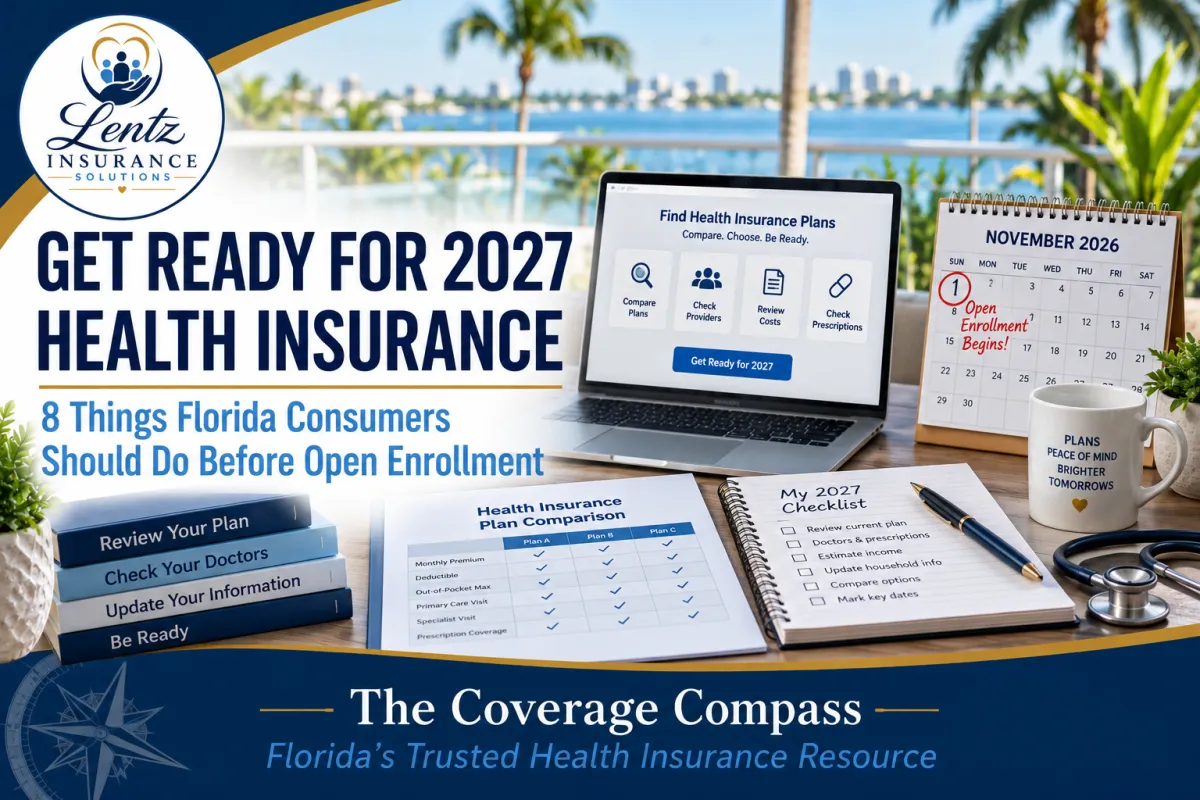
Florida Health Insurance: 8 Things to Do Before 2027 Open Enrollment
Florida Health Insurance: 8 Things to Do Before 2027 Open Enrollment
If you're like most people, health insurance probably isn't something you want to think about every day.
You choose a plan, put your insurance card in your wallet, and hope you don't need to use it too often.
But there is one time each year when it's worth taking a closer look:
Open Enrollment.
And if you're shopping for health insurance for 2027, you don't have to wait until November to start preparing.
In fact, September is a great time to get organized.
For Marketplace coverage, Open Enrollment runs from November 1 through January 15 each year. If you want coverage to begin January 1, December 15 is generally the deadline to enroll or change plans for that January 1 start date.
Whether you're currently insured, self-employed, changing jobs, or simply wondering whether your current coverage still makes sense, here are eight things you can do now to make the process easier.
1. Review Your Current Health Insurance Plan
One of the easiest mistakes to make during Open Enrollment is assuming:
"I'll just keep what I have."
Automatic renewal may be convenient, but it doesn't necessarily mean your current plan is still the best fit.
Health insurance plans, premiums, networks, and other details can change from year to year. Your own circumstances may also have changed.
HealthCare.gov specifically recommends updating your application, reviewing available plans, and comparing your options rather than simply assuming your existing coverage should continue unchanged.
Before deciding to renew, ask yourself:
What am I paying each month?
What is my deductible?
What is my maximum out-of-pocket?
Are my doctors still in-network?
Are my prescriptions covered?
Has anything changed about my plan?
Does this coverage still fit my needs?
If you need a refresher on what to look for when comparing plans, read our guide:
How to Compare Health Insurance Plans in Florida: 7 Things to Look At Before You Enroll
2. Make a List of Your Doctors and Prescriptions
Before you compare plans, make a list of the healthcare providers and medications that matter most to you.
Include:
Primary care physician
Specialists
Preferred hospital
Urgent care
Regular prescriptions
Preferred pharmacy
Then use that information when comparing plans.
A health insurance plan isn't very useful to you if your preferred doctor isn't in the network or your medication has an unexpectedly high cost.
Don't assume that because your doctor accepts insurance, they accept your particular plan.
Verify the actual plan network and prescription coverage.
If you have established relationships with specialists or a particular healthcare system, this step can be especially important.
3. Estimate Your 2027 Household Income
If you're considering Marketplace coverage, this is an especially important step.
HealthCare.gov says Marketplace savings are based on your expected household income for the year you're applying for coverage, rather than simply using past income.
This can be particularly important for:
Self-employed individuals
Independent contractors
Realtors
Business owners
Commission-based workers
People whose income varies throughout the year
If you're self-employed, you may have a more difficult time estimating next year's income than someone receiving a fixed salary.
Take the time to make a realistic estimate.
And if your circumstances change, remember that you can update your Marketplace application.
For more information specific to self-employed consumers, see our article on health insurance for the self-employed in Florida.
4. Review Your Household Information
Your health insurance situation isn't only about the plan.
Your household information can also affect your Marketplace application and potential savings.
Before Open Enrollment, consider whether anything has changed, such as:
Marriage
Divorce
Birth or adoption
A dependent aging off coverage
A change of address
A change in who you claim as a dependent
A change in household income
HealthCare.gov recommends updating household and income information so the Marketplace can provide current eligibility and savings information.
This is one reason I don't recommend simply copying last year's information and assuming nothing has changed.
Your life may have changed—even if your insurance card hasn't.
5. Look at the Whole Cost of Your Coverage
The monthly premium is important.
But it isn't the entire cost of health insurance.
When comparing plans, look at:
Premium
What you pay each month for coverage.
Deductible
What you generally pay for covered services before the plan begins paying its share, subject to the plan's rules.
Copayments
Fixed amounts you may pay for certain covered services.
Coinsurance
The percentage of an allowed amount you may pay for certain covered services.
Maximum Out-of-Pocket
The maximum amount you generally pay during the plan year for covered services under the plan's rules.
This is why a plan with a lower premium isn't automatically the least expensive option.
You have to consider how the plan works when you actually use healthcare.
That's also why comparing plans side-by-side can be so valuable.
Our article How to Compare Health Insurance Plans in Florida goes into these costs in more detail.
6. Determine What Type of Coverage You Need
Not everyone needs to shop for the same type of health insurance.
Depending on your circumstances, you may be considering:
Employer-sponsored coverage
ACA Marketplace coverage
Private individual health insurance
Coverage through a spouse
Other qualifying coverage options
If you're self-employed or don't have access to employer-sponsored coverage, you may have more than one avenue to explore.
That's why I believe the first question shouldn't always be:
"What's the cheapest health insurance plan?"
A better question is:
"What type of coverage makes sense for my situation?"
If you're trying to understand the difference between private and Marketplace coverage, our guide to Private Health Insurance vs. ACA Marketplace Plans is a good place to start.
7. Don't Assume Your Current Plan Is Still Your Best Option
This may be the most important advice in this entire article:
Don't renew on autopilot.
Your current plan may still be the right choice.
But it should be compared.
HealthCare.gov says plans and prices can change each year and encourages Marketplace consumers to compare available plans during Open Enrollment.
You may discover:
A plan with a better provider network
Different prescription coverage
A different deductible structure
A different premium
A plan that better matches your healthcare usage
Another option that better fits your budget
If you're automatically re-enrolled, you can still compare plans during Open Enrollment and change to another available plan.
Your current plan deserves to compete for your business every year.
8. Know the Important Open Enrollment Dates
If you're shopping for Marketplace coverage for 2027, put these dates on your calendar now.
November 1, 2026
Open Enrollment begins.
This is the first day to enroll in, renew, or change Marketplace coverage for 2027.
December 15, 2026
Generally the deadline for coverage beginning January 1, 2027.
January 15, 2027
Open Enrollment ends.
If you enroll between December 16 and January 15, coverage generally begins February 1, assuming you meet the applicable requirements.
One important reminder
Don't wait until January 15 if you can avoid it.
Giving yourself time to compare plans is much better than making a rushed decision because a deadline is approaching.
Your September Health Insurance Checklist
You don't have to choose a plan today.
But you can prepare today.
Start now:
☐ Find your current insurance plan information
☐ Write down your current premium
☐ Find your deductible
☐ Find your maximum out-of-pocket
☐ Make a list of your doctors
☐ Make a list of your prescriptions
☐ Identify your preferred hospital
☐ Review your expected 2027 income
☐ Review your household information
☐ Think about your expected healthcare needs
☐ Decide whether your current type of coverage still makes sense
☐ Put November 1 on your calendar
Then, when Open Enrollment arrives, you'll already have the information you need to make a more informed comparison.
What If You Need Health Insurance Before November?
Open Enrollment isn't the only time people can obtain health coverage.
If you're outside the Marketplace Open Enrollment period, you may qualify for a Special Enrollment Period because of certain qualifying life events, such as losing other health coverage, getting married, having a baby, or moving.
There are also other coverage pathways depending on your individual circumstances.
If you need coverage before November, don't automatically assume you have to wait.
Our guide to health insurance options outside Open Enrollment explains some of the situations to consider.
The Bottom Line
You don't need to wait until November to start thinking about health insurance.
In fact, the best time to prepare is before you're under a deadline.
Review your current plan.
Know your doctors.
Check your prescriptions.
Estimate your income.
Review your household information.
Understand your costs.
And when Open Enrollment arrives, compare your options carefully.
Health insurance is personal.
The plan that's right for one person may not be right for another.
The goal isn't to find the "best" plan.
It's to find the coverage that makes sense for your health, your budget, and your circumstances.
That's what The Coverage Compass is here to help you do.
Frequently Asked Questions
When is Open Enrollment for 2027 health insurance?
For Marketplace coverage, Open Enrollment runs from November 1, 2026 through January 15, 2027.
When should I start comparing health insurance plans?
You can start preparing before Open Enrollment by reviewing your current plan, doctors, prescriptions, household information, and expected income. Then compare the available 2027 plans once they are available during Open Enrollment.
Do I have to keep my current health insurance plan?
No. During Marketplace Open Enrollment, you can review available plans and choose a different plan if another option better meets your needs.
Can my health insurance premium change from year to year?
Yes. Plan prices and other details can change from year to year. That's one reason it's important to review your coverage rather than automatically renewing without comparing your options.
What if my income changes?
If you have Marketplace coverage, update your expected income and household information because changes can affect your eligibility for savings and the amount of financial assistance you receive.
Can I get health insurance outside Open Enrollment?
Possibly. You may qualify for a Special Enrollment Period after certain qualifying life events. Medicaid and CHIP also have year-round application opportunities for people who qualify.
Should I choose the plan with the lowest premium?
Not necessarily. The premium is only one part of the cost. Consider the deductible, copayments, coinsurance, maximum out-of-pocket, provider network, prescription coverage, and your expected healthcare needs.
What should I compare besides the monthly premium?
At minimum, compare the deductible, maximum out-of-pocket, provider network, prescription coverage, copays, coinsurance, covered services, and plan rules.
Need Help Comparing Your Options?
Every person's situation is different.
Whether you're reviewing your current coverage, preparing for Open Enrollment, becoming self-employed, or simply wondering whether your current plan still fits your needs, I'm happy to help you understand your options.
Talk through your options with confidence.
Becky Lentz
Independent Health Insurance Broker
Lentz Insurance Solutions
Helping you protect what matters most—with guidance and trust.
This article is for educational purposes only. Health insurance plans, benefits, networks, premiums, deductibles, eligibility requirements, financial assistance, and enrollment rules vary. Always review current plan documents and eligibility information before enrolling.

