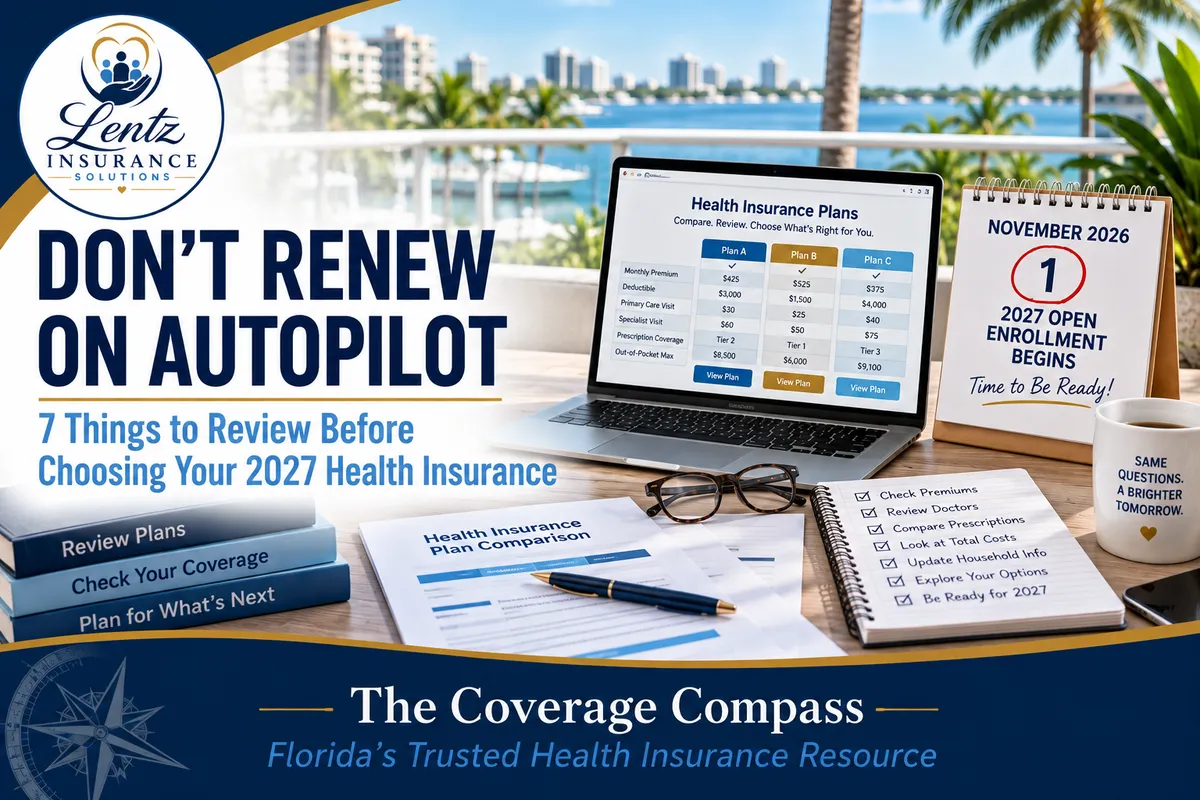
Why You Shouldn’t Renew Your Florida Health Insurance on Autopilot
Why You Shouldn’t Renew Your Florida Health Insurance on Autopilot for 2027
Fall is approaching, which means many Floridians will soon be thinking about health insurance for 2027.
For some people, the easiest approach may seem to be simply keeping the plan they already have. After all, if your coverage worked this year, why change it?
The problem is that your plan, your costs, your doctors, your prescriptions, or your own circumstances may have changed.
That is why renewal season is a good time to pause and take another look at your coverage before deciding what to do for 2027.
For Marketplace coverage, HealthCare.gov specifically recommends reviewing your application information and comparing available plans during Open Enrollment rather than simply assuming your current plan is still the right fit.
1. Your Premium Can Change
One of the first things people notice at renewal is the monthly premium.
Even when you are happy with your current coverage, the amount you pay each month can change for the new plan year.
That means a plan that fit comfortably within your budget in 2026 may cost more in 2027—or another plan may offer a different combination of premium and benefits.
And monthly premium is only one part of the equation.
When comparing health insurance, it is important to look at the overall cost of coverage, including deductibles, copays, coinsurance, and the out-of-pocket maximum.
For a deeper look at how to evaluate those numbers, see:
How to Compare Health Insurance Plans in Florida: 7 Things to Look At Before You Enroll
HealthCare.gov also provides tools that allow consumers to compare plan information and estimated costs.
2. Your Deductible and Out-of-Pocket Costs Can Change
A lower premium does not necessarily mean lower overall healthcare costs.
Your deductible, copays, coinsurance, and out-of-pocket maximum all play a role in determining what you could actually spend during the year.
For example, two plans might have similar monthly premiums but very different deductibles and cost-sharing structures.
That difference could become important if you see specialists regularly, take several prescriptions, have a planned procedure, or simply want more predictable healthcare costs.
When reviewing a renewal, don't look only at the premium.
Ask:
What could this plan actually cost me if I use my healthcare?
HealthCare.gov recommends considering total yearly costs—not just the monthly premium—when comparing plans.
3. Your Doctors and Hospitals May Not Be the Same
A health plan is only useful if it works with the providers you want to use.
Before renewing, check whether your:
primary care physician
specialists
preferred hospital
urgent care locations
other frequently used providers
are still included in the plan's network.
This is especially important in Florida, where consumers may have access to different plans and network structures depending on where they live.
Don't assume that because your doctor was in-network this year, you should automatically assume everything will be identical next year.
Make provider network review part of your annual renewal checklist.
4. Your Prescription Coverage Matters Too
If you take regular medications, reviewing your prescription coverage should be part of your renewal process.
Look at the plan's drug coverage and ask:
Is my medication still covered?
Has the copay changed?
Is there a different tier?
Are there pharmacy network requirements?
Do I need prior authorization or step therapy?
A plan that looks attractive based on its premium can look very different once you factor in your prescription costs.
This is one more reason not to compare plans based on price alone.
5. Your Current Plan May Not Be Available for 2027
One assumption I hear often is:
"I already have a plan, so I'll just keep it."
For Marketplace coverage, that isn't necessarily how renewal works.
HealthCare.gov explains that when a Marketplace plan is no longer offered, consumers may be matched with another plan. During Open Enrollment, you can update your application and review the plans available for the new year.
That means the renewal notice you receive should not automatically be treated as the end of the conversation.
It should be treated as a reason to review what is available.
6. Your Income and Household Situation Can Affect Marketplace Savings
This is particularly important for self-employed individuals, business owners, freelancers, and anyone whose income can change from year to year.
Marketplace savings are based on your expected household income for the year you are applying for coverage, rather than simply using your previous year's income. Household composition also matters.
That means changes such as:
a significant change in business income
marriage or divorce
a change in household members
gaining or losing other health coverage
can affect your Marketplace application and potential savings.
HealthCare.gov advises consumers to update their application when income or household circumstances change.
For self-employed Floridians, estimating annual income can be particularly important because income may not be as predictable as a traditional employee's paycheck.
For more information on coverage options for independent professionals, read:
Health Insurance for the Self-Employed in Florida: What Are Your Options?
7. Your Health Insurance Needs May Have Changed
Perhaps the biggest reason not to renew on autopilot is simple:
You may not need the same plan you needed last year.
Maybe your income changed.
Maybe you changed jobs or became self-employed.
Maybe you've added or removed someone from your household.
Maybe you started seeing a specialist.
Maybe your prescriptions changed.
Maybe you moved.
Or maybe you simply realized that your current plan isn't providing the value you expected.
Your health insurance should reflect your current situation, not automatically carry over from the previous year.
That's why annual review matters.
A Simple 2027 Health Insurance Renewal Checklist
Before choosing your 2027 coverage, take a few minutes to review:
☐ Monthly premium
☐ Deductible
☐ Copays and coinsurance
☐ Out-of-pocket maximum
☐ Doctors and hospitals
☐ Prescription coverage
☐ Network structure
☐ Expected healthcare needs
☐ Household information
☐ Estimated 2027 income
☐ Whether your current plan is still available
☐ Other plans that may better fit your needs
This is also a good time to revisit:
Private Health Insurance vs. ACA Marketplace Plans
Understanding the difference between these types of coverage can help you determine what options may be worth exploring based on your circumstances.
And if you are wondering whether you can make a change outside of Open Enrollment, see:
Health Insurance Options Outside Open Enrollment
When Is 2027 Open Enrollment?
For the federal Marketplace, Open Enrollment for 2027 coverage begins November 1, 2026 and runs through January 15, 2027.
Generally, enrolling or changing plans by December 15 allows coverage to begin January 1, 2027. Plans selected after December 15 but during the remainder of Open Enrollment generally begin February 1.
That gives you time to review your options rather than waiting until the last possible minute.
What If You Need Coverage Before November?
Open Enrollment is not the only way someone may qualify for health coverage.
Outside of Marketplace Open Enrollment, you may still qualify for a Special Enrollment Period because of certain life events, such as losing other health coverage, moving, getting married, or having a baby.
There may also be other coverage options depending on your circumstances.
That's why I don't recommend assuming that Open Enrollment is your only opportunity to find coverage.
My previous article, Can You Get Health Insurance Outside Open Enrollment in Florida?, goes into more detail about those situations.
Don't Forget Your HSA
For people with HSA-eligible coverage, renewal is also a good time to review whether your new plan still aligns with your HSA strategy.
A change in plan design can affect whether you are eligible to contribute to an HSA.
For a closer look at how HSAs and health insurance work together, read:
HSA & Health Insurance: What Florida Consumers Need to Know
The Bottom Line
Renewing your health insurance doesn't have to be complicated.
But it should be intentional.
Before you simply click renew, take a few minutes to look at your premium, deductible, provider network, prescriptions, out-of-pocket exposure, household information, and expected income.
Your current plan may still be the right fit for 2027.
Or you may discover another option that better matches your needs.
The important thing is to review before you renew.
And remember, you don't have to wait until the last week of Open Enrollment to start looking.
The Coverage Compass is designed to help Florida consumers better understand health insurance, one topic at a time.
Frequently Asked Questions
Do I have to change my health insurance plan every year?
No. You may be able to keep your current plan, depending on the coverage and whether it remains available. The important step is reviewing your options before deciding to renew.
Can my health insurance premium change at renewal?
Yes. Health insurance premiums and other plan costs can change from one plan year to another. Review the new plan information before automatically renewing.
Should I compare health insurance plans every year?
For Marketplace coverage, HealthCare.gov specifically recommends reviewing and comparing available plans during Open Enrollment.
What if my income changed?
If you have Marketplace coverage, update your application when your income or household information changes. Your projected household income helps determine eligibility for Marketplace savings.
What if my doctor is no longer in my plan's network?
That is an important reason to review your plan before renewing. Check the provider network for the plan you're considering before making a decision.
What if I need health insurance before Open Enrollment?
You may qualify for a Special Enrollment Period because of a qualifying life event. Other coverage options may also be available depending on your circumstances.
Need Help Comparing Your Options?
Every person's situation is different.
Whether you're reviewing your current coverage, preparing for Open Enrollment, becoming self-employed, or simply wondering whether your current plan still fits your needs, I'm happy to help you understand your options.
Talk through your options with confidence.
Schedule a Conversation with Becky →
The Coverage Compass | Florida’s Trusted Health Insurance Resource I Lentz Insurance Solutions

